License Management
Activating Your License - Direct Purchase
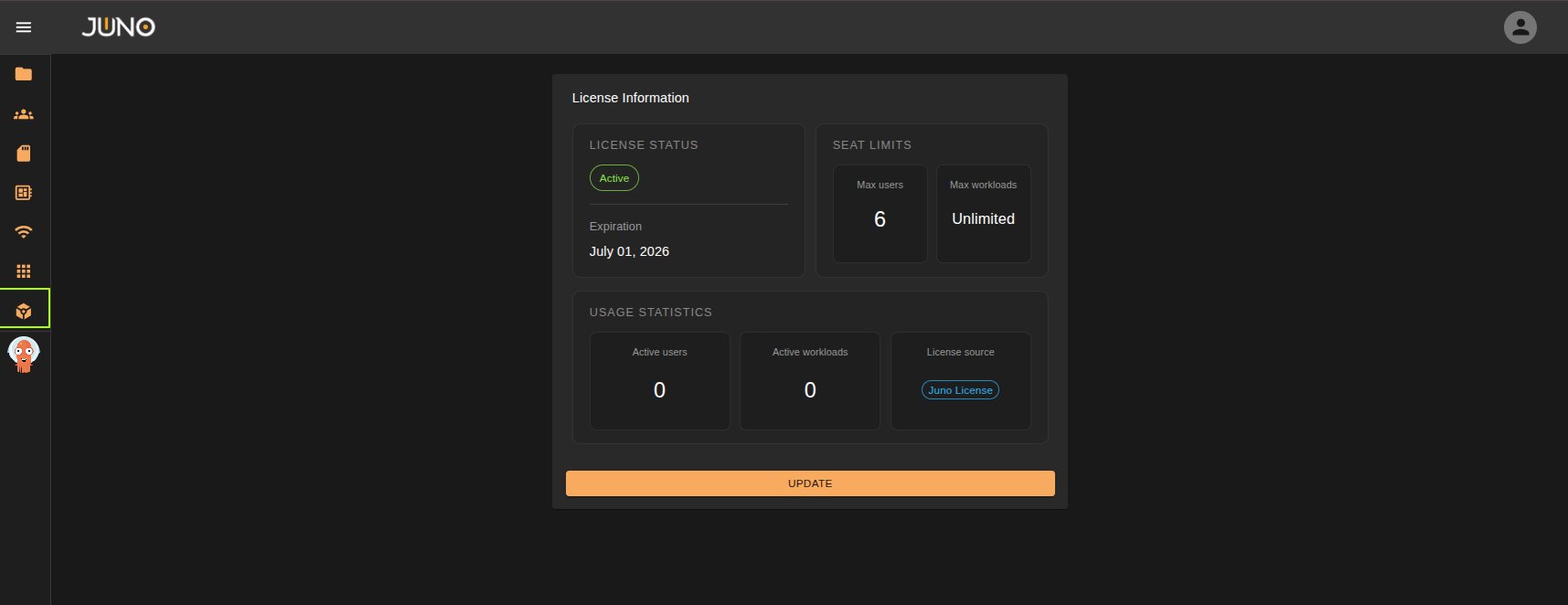
Upon purchasing from Juno, you will receive a license key via email from our team. This key is added to Genesis via the licensing page, accessible by admin users on the Genesis sidebar navigation. after the deployment process to validate your subscription and activate all licensed services. You can also update your license at any time via the Genesis web UI, under the "Licensing" tab following the same process as initial setup.
If you haven't received your license key or need assistance, please contact our sales team at sales@juno-innovations.com. We aim to respond to all inquiries within one business day.
Activating Your License - AWS Marketplace
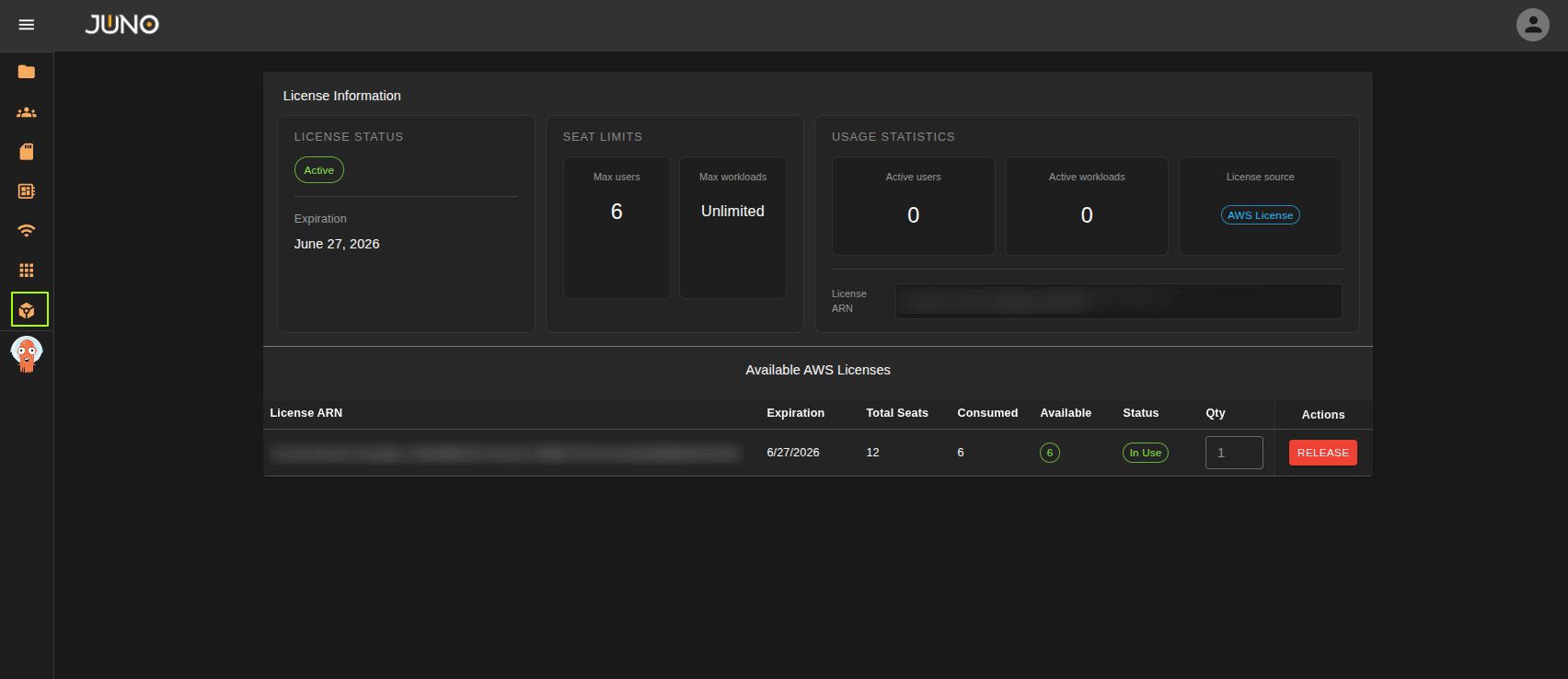
If a license was purchased via the AWS Marketplace, you will be able to check out your license entitlements directly from the Genesis Licensing page, accessible by admin users on the Genesis sidebar navigation.
Simply navigate to the license table, choose how many seats you'd like to checkout for the given license, and click the checkout button. If you wish to release these seats, you can then click the release button.
Pre-reqs for the AWS Marketplace Integration:
Tip
Please note all of these pre-reqs will be taken care of automatically via our oneClick installer
- IAM roles and policies created to allow interaction with the AWS license manager.
- AWS_MARKETPLACE environment variable set to "enabled" in the Genesis application
- AWS_REGION environment variable set to the cluster region in the Genesis application
If you need assistance, please contact our support team at sales@juno-innovations.com. We aim to respond to all inquiries within one business day.
Community Edition
We provide a Community Edition to enable you to evaluate, as well to support open-source developers that contribute to Helios, our containerized workload platform.
The Community Edition enables you to run up to 2 workloads for free, indefinitely and without any other restrictions on workload functionality.
User & Workload Allowance
If your license is issued for a set amount of users, each user is allowed to spawn as many workloads as they wish. This means you can have up to 20 unique users spawn multiple machines each. The license cap counts unique users across all your workloads.
There is no limit on the amount of users allowed to log into the platform. Only users with active workloads count against the allowance.
For workload-bound licenses, the amount of users is not considered and only the amount of running workloads is evaluated.
Consumption Allowance
Consumption based licenses are not bound to a set amount of users or workloads. Instead, each consumption token is issued with a balance of CPU core hours, and you are only charged for the CPU your running workloads actually use. This means you can run as many users and workloads as you like, for as long as your remaining CPU core hours allow.
How Consumption Is Measured
The Metrics Gatherer scrapes the CPU core usage of every running workload in the cluster once a minute. At the end of each hour, the average of those scrapes is taken and that value, in CPU core hours, is deducted from the total CPU core hours remaining on your active consumption token.
Because usage is averaged over the hour rather than sampled at a single point in time, short spikes in workload activity have a limited impact on your balance, and workloads that are idle cost very little.
Note
The Metrics Gatherer must be able to communicate with every node in the cluster for consumption to be tracked accurately. Nodes it cannot reach are flagged as Misconfigured and will not have new workloads scheduled onto them. See our Networking documentation for details.
The 2 Free Workloads
The Community Edition allowance of 2 free workloads is preserved under consumption licensing. On every scrape, the 2 workloads with the lowest CPU core usage are dropped from the count, so they never count against your remaining CPU core hours.
As an example, if only 2 workloads are running in the cluster, both are dropped and no CPU core hours are deducted from your balance for that period.
Minimum Usage
If the combined CPU core usage of all counted workloads in a scrape falls below 0.25 cores, the value for that scrape is recorded as 0.25 cores. This is a running minimum applied to the cluster total, not an amount added to each workload, and it only takes effect when the total for the whole cluster is under 0.25 cores.
The minimum is applied after the 2 lowest usage workloads have been dropped, so it never applies to your 2 free workloads. If 2 or fewer workloads are running, there is nothing left to charge for and no minimum is recorded.
Reviewing Your Consumption
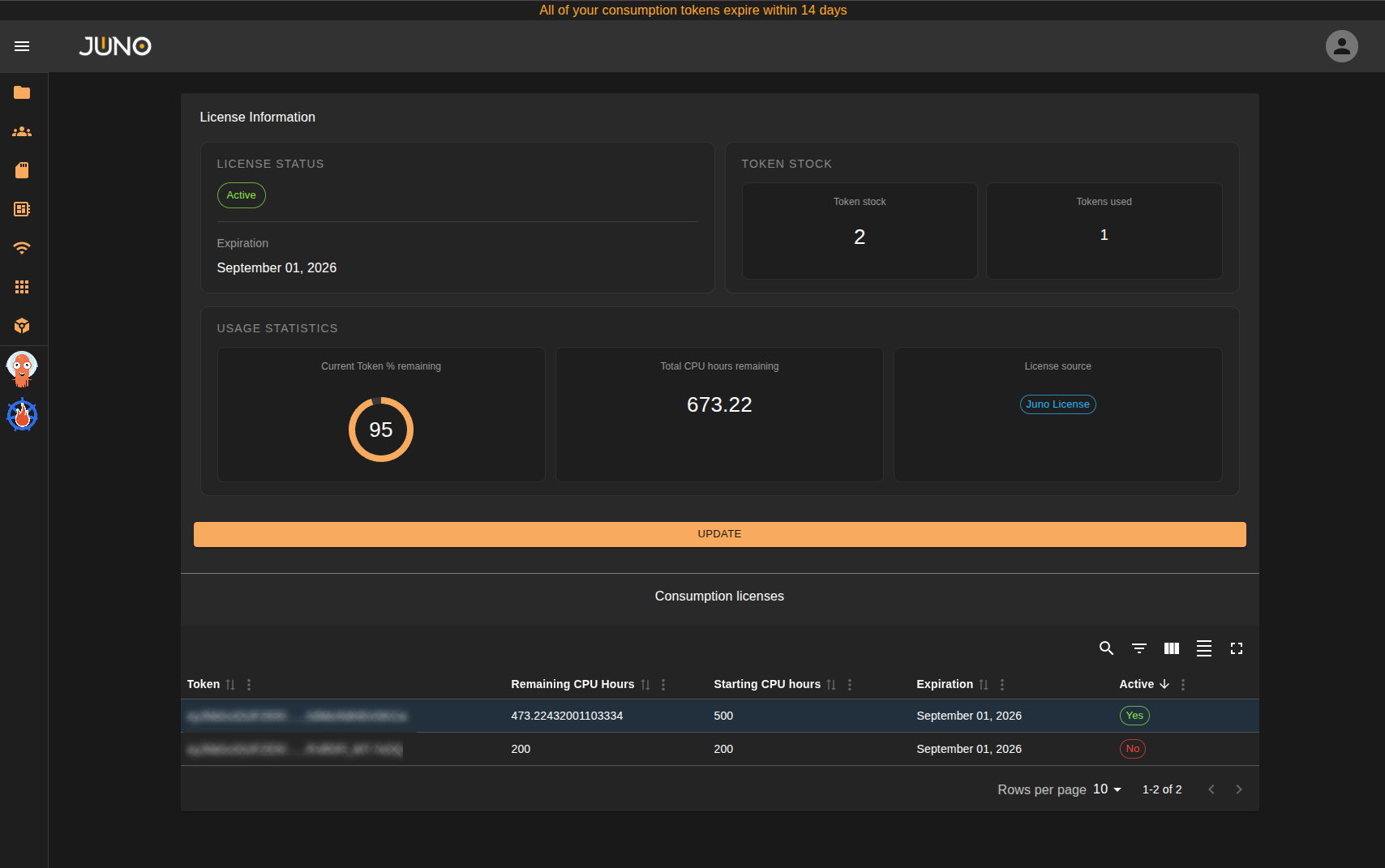
The Licensing page shows the state of your consumption tokens:
- Token stock - the number of consumption tokens issued to your cluster, and how many of those have been used.
- Current Token % remaining - the percentage of CPU core hours left on the token that is currently active.
- Total CPU hours remaining - the total CPU core hours left across all of your consumption tokens.
- Consumption licenses - a table of every token, with its remaining and starting CPU core hours, its expiration date, and whether it is the token currently being drawn down.
Tokens are consumed one at a time. When the active token is exhausted, the next token in your stock becomes active. A banner is displayed at the top of the page when your consumption tokens are approaching their expiration date.
For a view of your consumption over time, including an estimate of how long your active token will last at your current rate of usage, see the Consumption token usage dashboard in our Metrics Gatherer documentation.
If you would like to add more consumption tokens to your cluster, please contact our sales team at sales@juno-innovations.com.